
AI-Powered Legal Research Assistant
We partnered with a U.S.-based LegalTech firm to build a next-generation research platform. By fusing Retrieval-Augmented Generation (RAG) with Multi-Agent Orchestration (LangGraph), we created a system that analyzes thousands of case files, accelerating legal research by 70%.
The Impact Dashboard (Metrics)
The "Keyword Search" Trap
Legal professionals were drowning in data. Traditional keyword search engines failed to capture the nuance of legal reasoning, often returning hundreds of irrelevant judgments that associates had to sift through manually. Furthermore, analyzing complex, 200-page case files for specific precedents was a slow, error-prone process that delayed case preparation.
Key Bottlenecks
Semantic Blindness
Keyword searches missed relevant cases that used different terminology (e.g., "emotional distress" vs. "mental anguish").
Volume Overload
Manually summarizing 50+ long-form judgments for a single brief was unsustainable.
Hallucination Risk
Generic AI tools often invented case citations, making them unusable for professional legal work.
Complex Reasoning
Identifying "conflicting precedents" across jurisdictions required multi-step logic that simple search couldn't handle.
Client Profile
Industry
Region
United States
Focus
Litigation Support Platform
Core Tech
LangChain, LangGraph, Pinecone, OpenAI GPT-4, FastAPI
Multi-Agent Legal Reasoning Engine
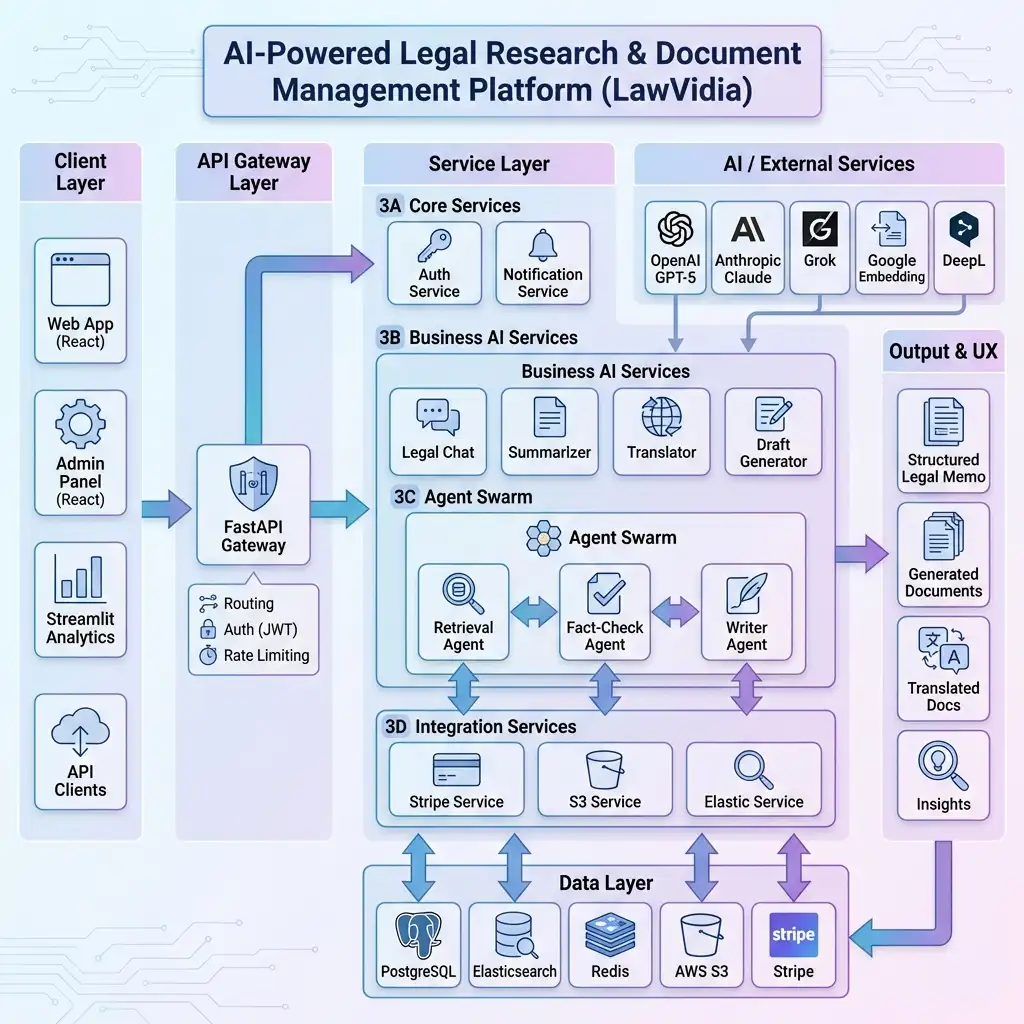
Inexture.ai engineered a Multi-Agent RAG System orchestrated via LangGraph. Instead of a simple “search and summarize” loop, specialized agents collaborate: a Retrieval Agent finds semantic matches, a Citing Agent verifies references against the vector database, and a Reasoning Agent synthesizes the findings into a structured legal memo.
Engineering The Platform
Semantic Case Retrieval
Replaced keyword search with dense vector retrieval using embedding models fine-tuned on legal corpora. This allows the system to find cases with similar legal principles, not just matching words.
Improved retrieval relevance by 85%.
Multi-Agent Orchestration
Used LangGraph to define a "Research Workflow." If the Retrieval Agent finds conflicting cases, a "Conflict Resolution" node is triggered to analyze the discrepancy before generating the final answer.
Mimics the thought process of a senior associate.
Automated Summarization
A specialized summarization pipeline that breaks down 100-page judgments into structured sections: "Facts," "Issues," "Holding," and "Reasoning."
Allows lawyers to digest complex case files in minutes.
Compliance & Citation Check
A dedicated "Audit Agent" that cross-references every generated claim against the source text to ensure zero hallucinations. If a citation doesn't exist in the database, the claim is flagged or removed.
Ensures the tool is safe for high-stakes legal work.
Business Impact
Research Velocity
70% reduction in research time, enabling firms to take on more cases without increasing headcount.
Work Product Quality
Higher quality briefs produced in less time, with AI uncovering relevant precedents that manual searches often missed.
Adoption
Widespread enterprise adoption by partner law firms who trust the system's "Citation-Backed" output over generic chatbots.
Relevant Enterprise Solutions
Document AI & Intelligent Document Processing
Document AI & Intelligent Processing (IDP) Automate document-heavy workflows with AI-powered extraction and validation. From invoices and KYC documents to...
View Document AI & Intelligent Document ProcessingCompliance & Regulatory Intelligence
Compliance & Regulatory Intelligence (RAG Copilots) Automate compliance research, policy interpretation, and documentation analysis with Enterprise RAG Copilots. Our AI...
View Compliance & Regulatory Intelligence